


LDAR tech delivers value only when its numbers can be trusted. The fastest optical gas imaging camera or the most sensitive laser analyzer is useless if the sensor has slipped out of calibration. Most conversations about leak detection and repair focus on detection methods and compliance schedules, yet the calibration layer underneath every reading decides whether your data holds up during an audit.
Modern LDAR equipment now ships with automated calibration capabilities that keep sensors accurate without adding paperwork. These features are changing how facilities manage accuracy, staffing, and documentation. At Osten Laboratory Limited, we treat calibration as the backbone of reliable fugitive emissions monitoring, and we have integrated automated systems across oil and gas, manufacturing, and power assets throughout Nigeria and other African markets.
This guide explains what LDAR technology does, the tools technicians carry, why sensor accuracy is non-negotiable, and how automation cuts manual workload while keeping programs inspection-ready.
What LDAR tech does at industrial facilities
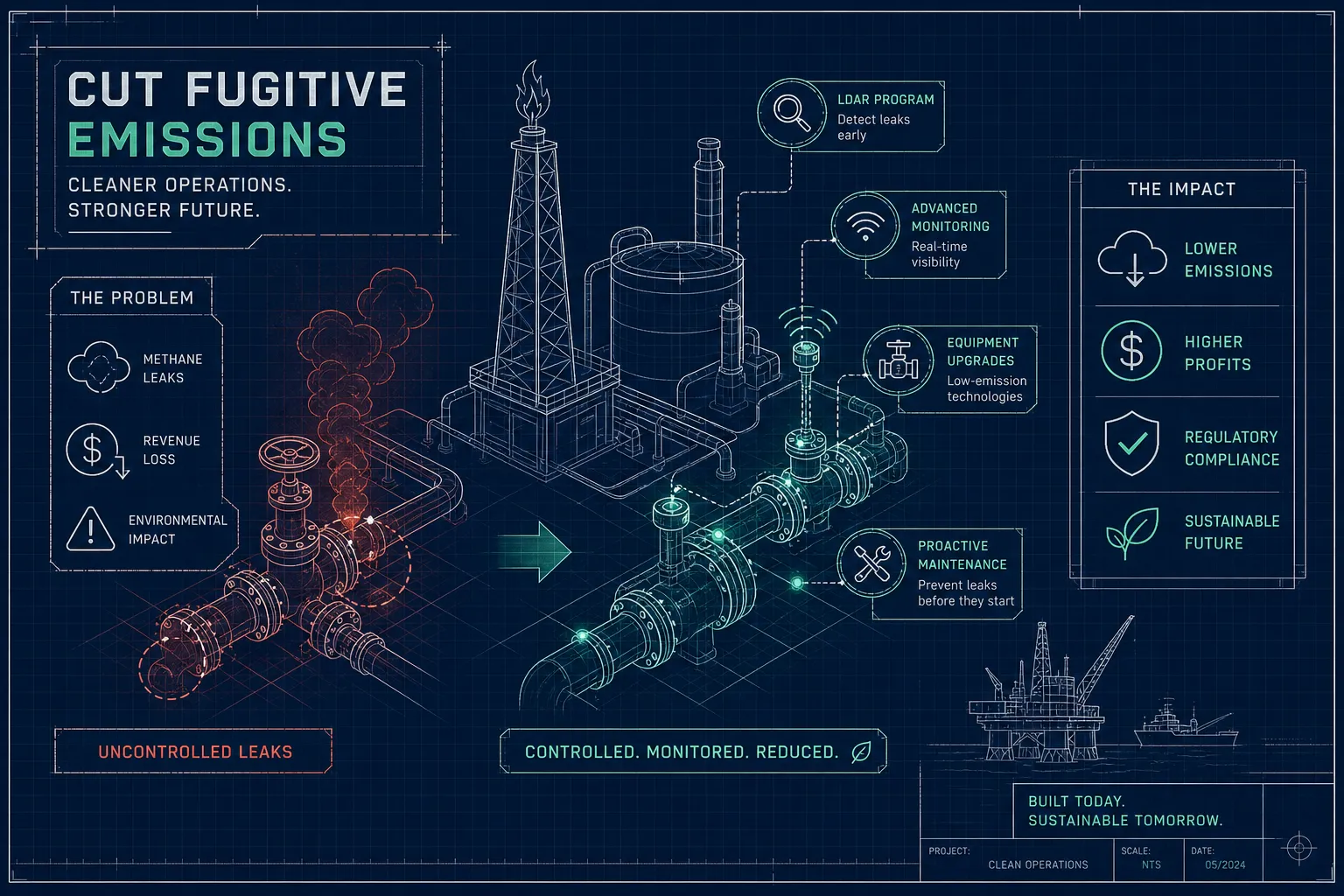
Leak detection and repair programs are designed to identify and fix fugitive emissions of VOCs, hazardous air pollutants, and methane from components like valves, pumps, compressors, flanges, and connectors. The goal is not simply to find leaks, it is to document them correctly and ensure repairs occur within regulatory timelines so your site stays in compliance.
The LDAR technician is the person who turns that policy into practice. They conduct systematic fugitive emissions surveys, tag and document every regulated component, coordinate repairs, and verify that fixes meet the standard. Instrument calibration is also their responsibility, because every reading logged is only as solid as the instrument behind it. For a broader perspective on how LDAR fits across sectors, see our article The Vital Role of Leak Detection and Repair (LDAR) Across Industries.
Daily field responsibilities of an LDAR technician
LDAR fieldwork is structured and methodical. Technicians follow P&ID routes, perform instrument-based scans and AVO checks, capture background conditions, and record results digitally to maintain traceable QA/QC. Many assignments are solo at remote sites, so technicians carry rugged, calibrated gear and verify instrument performance before each survey begins. EPA standards, specifically EPA Method 21 under 40 CFR Part 60, require instrument verification before monitoring starts, and that expectation drives the technician’s daily rhythm. When tools are right, the data stands up. When tools drift, everything downstream becomes suspect.
- Conduct instrument surveys via EPA Method 21 and optical gas imaging (OGI)
- Tag components, record leak size and conditions, and issue daily reports
- Coordinate repairs, then confirm post-repair compliance and documentation
Regulatory scope driving LDAR activity
In 2026, VOC and HAP regulations are fully enforceable across the United States and mirrored by many state and local programs. 40 CFR Part 60 (NSPS) and NESHAP provisions, including the HON rule under Subpart H, continue to set expectations for component monitoring, leak thresholds, and repair timelines. Methane fee timelines may shift; for context on recent agency and policy updates affecting OGI and LDAR practice, review industry coverage of EPA methane policy changes and OGI implications for monitoring programs (OGI and LDAR policy changes). The core obligations that drive most LDAR work remain firmly in place.
The detection technologies that power modern LDAR programs
LDAR technology spans several detection methods, each with a different sensitivity, cost profile, and ideal use case. The right combination depends on your facility’s size, risk profile, and whether monitoring is periodic or continuous. No single tool covers all scenarios well, which is why successful programs blend techniques. For an accessible overview of LDAR approaches and when to apply them, see this practical LDAR primer (LDAR: leak detection and repair overview).
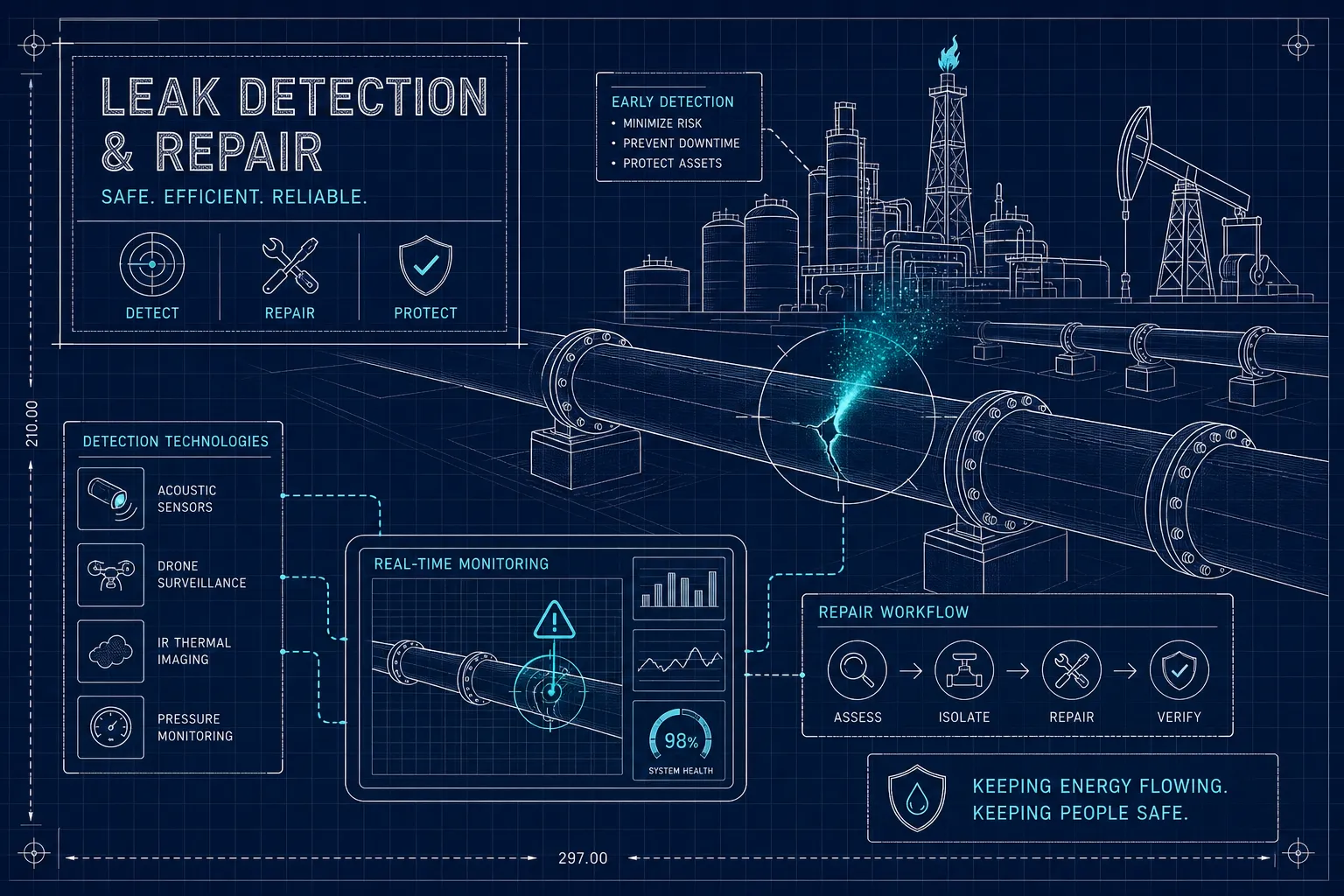
For most EPA-compliant fugitive emissions surveys, ground teams rely on OGI cameras for fast area screening and Method 21 analyzers for component-level confirmation. Laser-based tools and fixed sensors extend coverage to remote or hazardous zones, while drones increase reach across large or difficult terrain.
Optical gas imaging, handheld analyzers, and laser-based tools
OGI infrared cameras visualize hydrocarbon plumes and are effective for rapid screening. They help technicians home in on suspect areas before moving to pinpointing tools. Method 21 handheld analyzers, using FID or PID principles, scan component interfaces to quantify leaks at the ppm level, and a trained LDAR technician can typically work through 300 to 400 components per day with high precision.
Laser-based detectors, such as tunable diode laser absorption spectroscopy (TDLAS), add high sensitivity and selective methane leak detection for areas that are unsafe or out of reach. They can detect at very low concentrations from standoff distances, which is valuable around elevated piping or congested process racks. In practice, OGI and Method 21 remain the backbone of most compliance surveys, with laser tools augmenting coverage where ground access is restricted.
Fixed sensors and drone-based monitoring
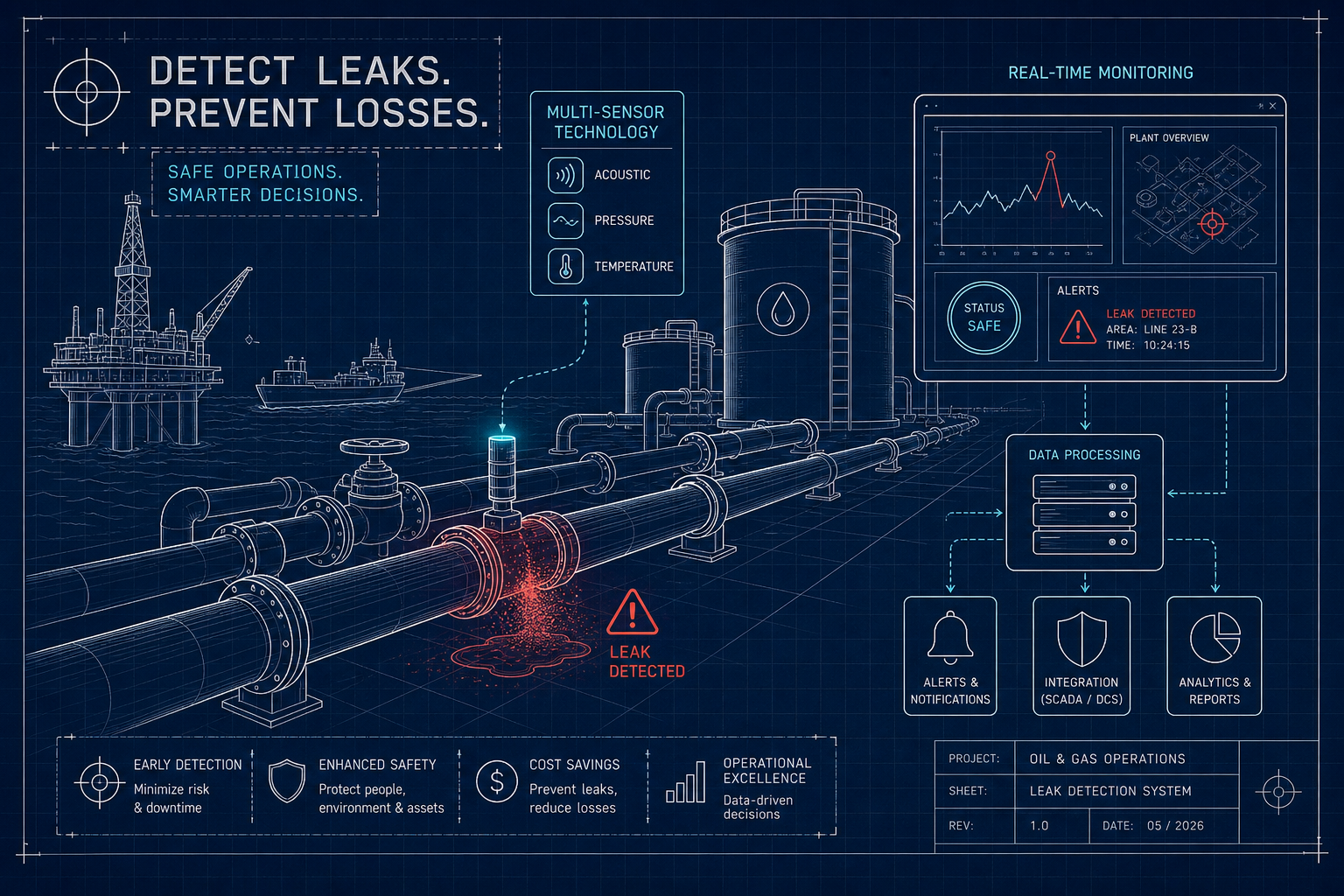
Facilities are expanding to continuous monitoring using fixed NDIR. Wireless backhaul via 4G or LoRaWAN extends coverage to remote pads and tank batteries, with alerts routed to operations dashboards and EHS teams. This architecture reduces blind spots between periodic surveys and supports faster repair cycles.
Drone fleets equipped with OGI or laser payloads are increasingly common at upstream sites and along pipeline corridors. They cover large areas quickly, especially where ground access is limited. Regardless of the detection platform, every device shares the same fundamental constraint: accuracy depends on calibration quality and traceability to accredited standards.
Why sensor calibration accuracy determines compliance outcomes
Gas sensors and analyzers drift with time, temperature, humidity, and contamination. Without routine verification against traceable reference standards, measurements slide away from true values. Drifted instruments underreport concentrations, which leads to missed repair triggers and audit exposure. Think of calibration as the chain of custody for your measurement data, if the primary reading is wrong, no amount of database rigor rescues the record.
What happens when instruments go uncalibrated
Consider a valve that shows 800 ppmv on a drifted analyzer when the actual concentration is 1,200 ppmv. That gap crosses the standard 1,000 ppmv repair threshold and produces a missed repair event. When auditors re-run the measurement with a verified instrument, findings escalate to NESHAP deviations and penalty exposure.
Older FID models were known for negative drift and flow restrictions that masked real leaks, a reason many consent decrees require midday drift checks. If a known 500 ppm span gas reads as 400 ppm, earlier measurements from that day become questionable and often require re-monitoring. A consistent maintenance and verification routine prevents that cascade and protects the integrity of your LDAR program compliance record.
Calibration frequency requirements under EPA standards
EPA Method 21 (40 CFR Part 60, Appendix A-7) requires an instrument zero and span check before each monitoring day using certified calibration gas mixtures and clean zero air. Logs must be complete and traceable. For a primary source on Method 21 procedures and expectations, consult the EPA Method 21 guidance document (EPA Method 21 guidance (PDF)). For continuous fixed networks, requirements are even more demanding because sensors run around the clock and must remain within tolerance at all times.
Handheld analyzers need daily verification, while fixed systems need scheduled zero and span checks plus diagnostics to catch drift in real time. The consistent requirement across all methods is traceability to accredited standards, that traceability is what lets you defend the numbers during an inspection.
How automated calibration in LDAR tech reduces manual workloads
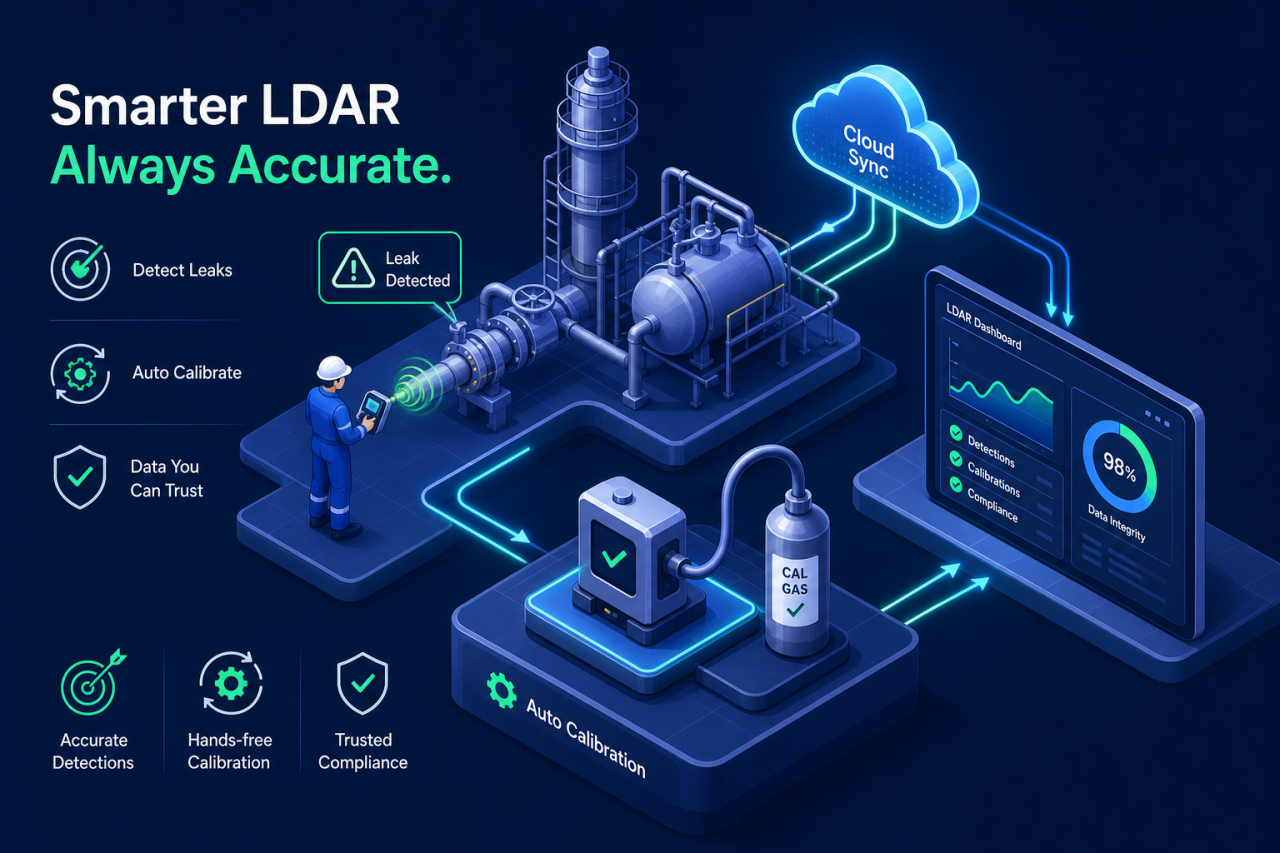
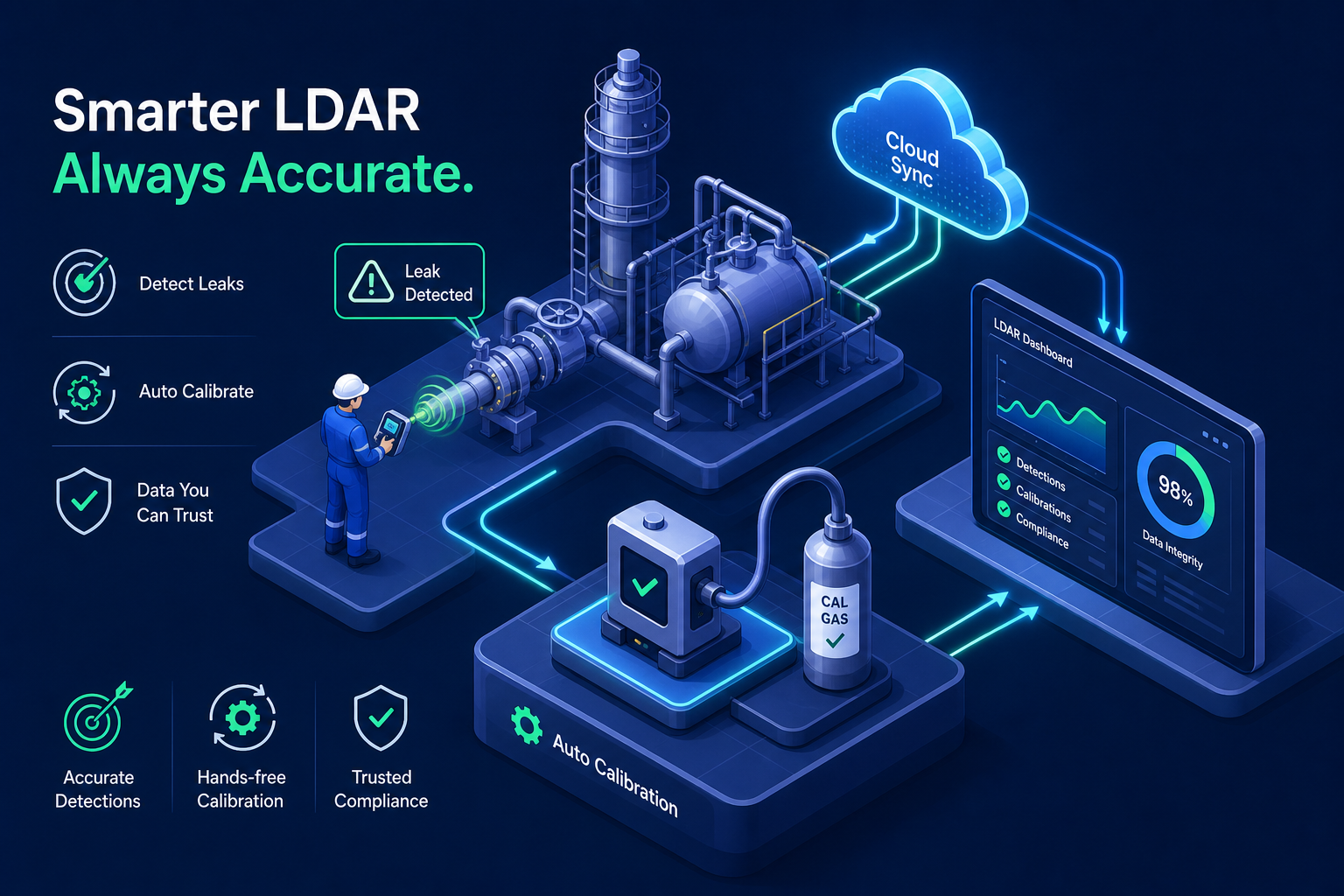
Modern LDAR equipment increasingly embeds automated calibration capabilities that keep sensors aligned while reducing paperwork. Examples include built-in auto-zero and span routines, onboard reference cells or cartridges, timed self-checks, and drift detection with instant alerts. Digital calibration logs capture who verified what and when, replacing paper binders with searchable records.
Fixed multi-gas sensors and TDLAS points can validate themselves against internal references at set intervals, then push results to SCADA or a calibration management system automatically. Docking stations for handheld FID/PID units automate daily zero and span checks, store results, and flag out-of-tolerance events before the crew heads into the field. That workflow creates complete, defensible audit trails with far fewer manual touches per device.
How auto-calibration maintains continuous sensor accuracy
Automated systems schedule self-checks and compare live readings against internal references or known gas cells. When deviation exceeds a set tolerance, the sensor initiates a re-zero or span correction, raises an alarm, or both. That prevents hours or days of accumulating error and keeps 24/7 monitoring networks inside compliance limits without waiting for a technician to catch the problem manually.
For portable gear, automation compresses the startup routine from many manual steps to a quick, guided workflow. Method 21 verification still happens, but with fewer keystrokes and no manual transcription. Over a quarter, that difference translates into more survey time and fewer re-runs caused by recordkeeping gaps.
The operational impact on LDAR technician workloads
Teams with automated calibration spend less time on routine setup and more time finding and fixing actual leaks. Human error in span adjustment and log-keeping drops, and rework during third-party audits falls with it. In Osten Laboratory Limited deployments, facilities consistently see fewer re-monitoring events because drift is flagged and corrected before it contaminates the daily dataset.
There is a cost benefit too. When fixed networks self-validate and portable units use automated docks, managers avoid dozens of manual verification touches per device per month. Scale that across a refinery or gas plant and the labor savings become significant, without any compromise to data quality.
Integrating LDAR tech into your existing calibration systems
Adopting new devices is only half the job. The other half is fitting them into your calibration management, SCADA, and asset workflows so accuracy is maintained and records are inspection-ready. Integration is where strong LDAR programs become resilient and weaker ones struggle during audits.
What system integration actually involves
- Map all instruments and current calibration intervals, including Method 21 analyzers and fixed sensors.
- Confirm protocol compatibility with SCADA or asset platforms, Modbus, OPC-UA, and CMMS linkages are common points of friction.
- Configure automated zero/span schedules and alarm thresholds by area classification and risk level.
- Establish traceability to ISO/IEC 17025-accredited standards, including certified gases and documented measurement uncertainty.
- Validate end-to-end data flow with a mock audit: measurement, calibration record, alert, and work order closeout.
Most integration failures come from a poor handoff between equipment vendors and the facility calibration team. Treating calibration as a system, not a device feature, prevents the gaps that surface during regulatory inspections.
How Osten Laboratory’s calibration experts streamline this process
Osten Laboratory Limited integrates modern LDAR equipment into existing measurement systems for oil and gas, power, and manufacturing operators. Our metrology specialists configure automated calibration routines, validate sensors against accredited reference standards, and connect outputs to SCADA and asset platforms for closed-loop corrective action. We maintain a clear chain of custody so every reading is traceable from sensor to record.
With hubs in Port Harcourt, Lagos, and Warri, we deliver local response backed by ISO/IEC 17025 traceability and hands-on experience with EPA-equivalent as well as NUPRC a and NESREA frameworks. For facilities that need LDAR tech to hold up during audits, starting with calibration integration, then scaling detection coverage, is the sequence that consistently produces inspection-ready results.
Certifications, and training for the 2026 LDAR market
Working professionally with LDAR equipment requires targeted technical training plus a firm grasp of safety and regulatory practice. Employers expect technicians to follow Method 21, operate OGI cameras competently, and manage data integrity in the field. Calibration literacy has become a genuine differentiator as facilities expand continuous monitoring networks.
Core training and certifications LDAR technicians need
- EPA Method 21 training: an 8-hour course covering procedures, QA/QC, response time, and recordkeeping requirements, for example, many providers offer dedicated EPA Method 21 training courses for LDAR compliance and monitoring
- OGI camera operation: at least 30 hours of supervised field training for junior operators, with progression to senior qualifications
- Instrument operation for FID/PID and laser tools: hands-on setup, verification, and drift checks
- Site-specific safety and regulatory training: confined space, lockout/tagout, H2S, and permit-driven requirements
- Data management proficiency: digital survey tools, calibration logs, and abnormal data pattern recognition
Third-party providers and state programs may add requirements, including periodic audits and refresher modules. A practical supplement worth pursuing is metrology basics for gas measurement, it gives technicians a working understanding of uncertainty, response factors, and traceability that directly improves field decision-making.
Key takeaways: LDAR tech and automated calibration
- Calibration accuracy is the foundation of LDAR program compliance, a drifted instrument undermines every reading it produces.
- Automated calibration features in modern LDAR equipment reduce manual workload, limit human error, and generate defensible audit trails.
- Integrating LDAR tech with SCADA, asset management, and ISO/IEC 17025-traceable calibration systems is what separates resilient programs from inspection risks.
- OGI cameras, Method 21 analyzers, TDLAS tools, and fixed sensor networks each fill a specific role, successful programs blend methods to match the facility’s risk profile.
- Technicians with calibration literacy and automated system experience are in strong demand through 2026 and beyond.
Conclusion
LDAR technology has moved well beyond handheld analyzers and paper logs. Automated calibration is a practical response to a straightforward reality: accurate fugitive emissions monitoring requires accurate instruments, and manual verification routines do not scale for 24/7 programs. When accuracy drifts, compliance drifts with it.
The return on getting calibration right is concrete. You cut manual workload, tighten documentation, reduce audit findings, and can actually trust your methane leak detection data. Technology adoption performs best when paired with calibration expertise, whether you upskill your own team or partner with a specialist who already has the infrastructure and accreditation in place.
Osten Laboratory Limited helps industrial operators integrate LDAR tech with accredited calibration services that meet local and international standards. Ready to make your program inspection-ready? Request a calibration audit or visit our LDAR and calibration services page to discuss your facility’s needs with our team.
