

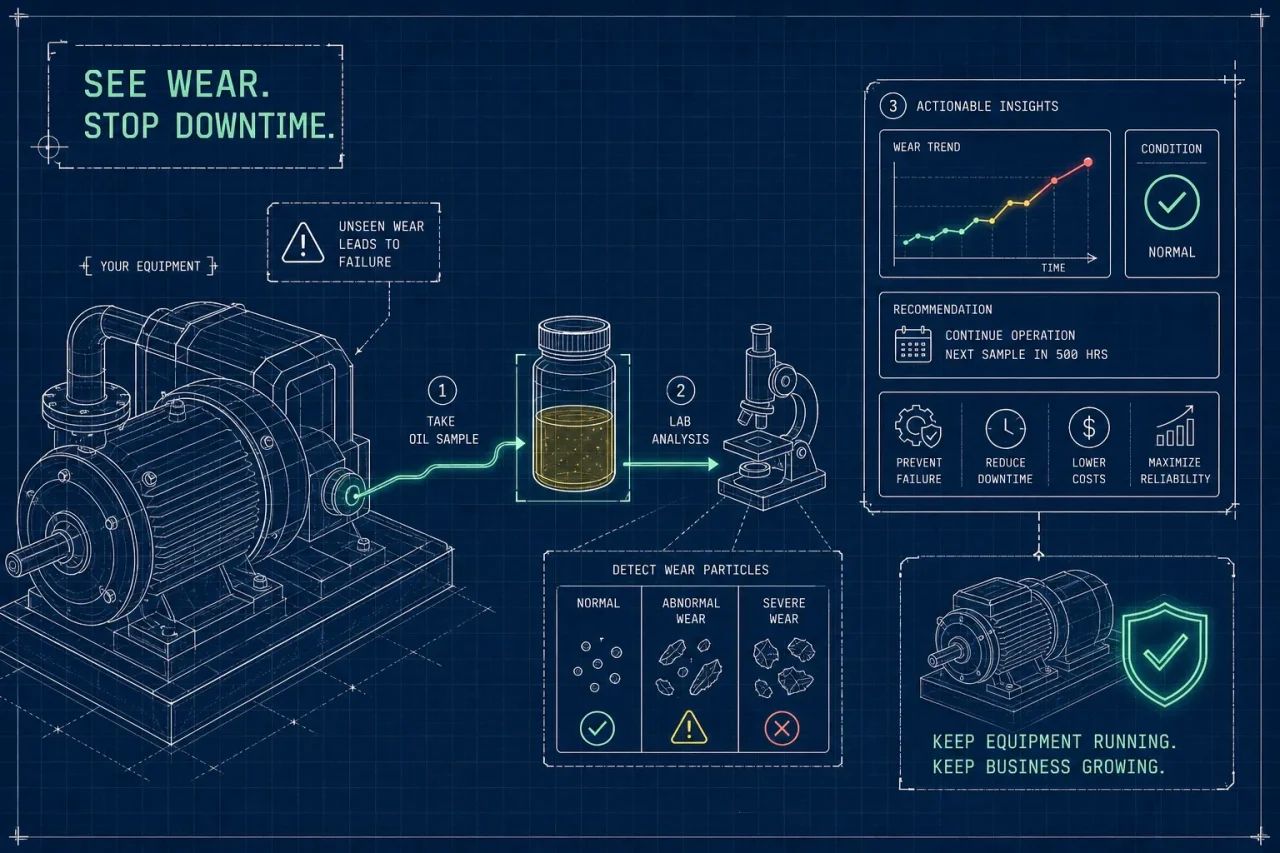
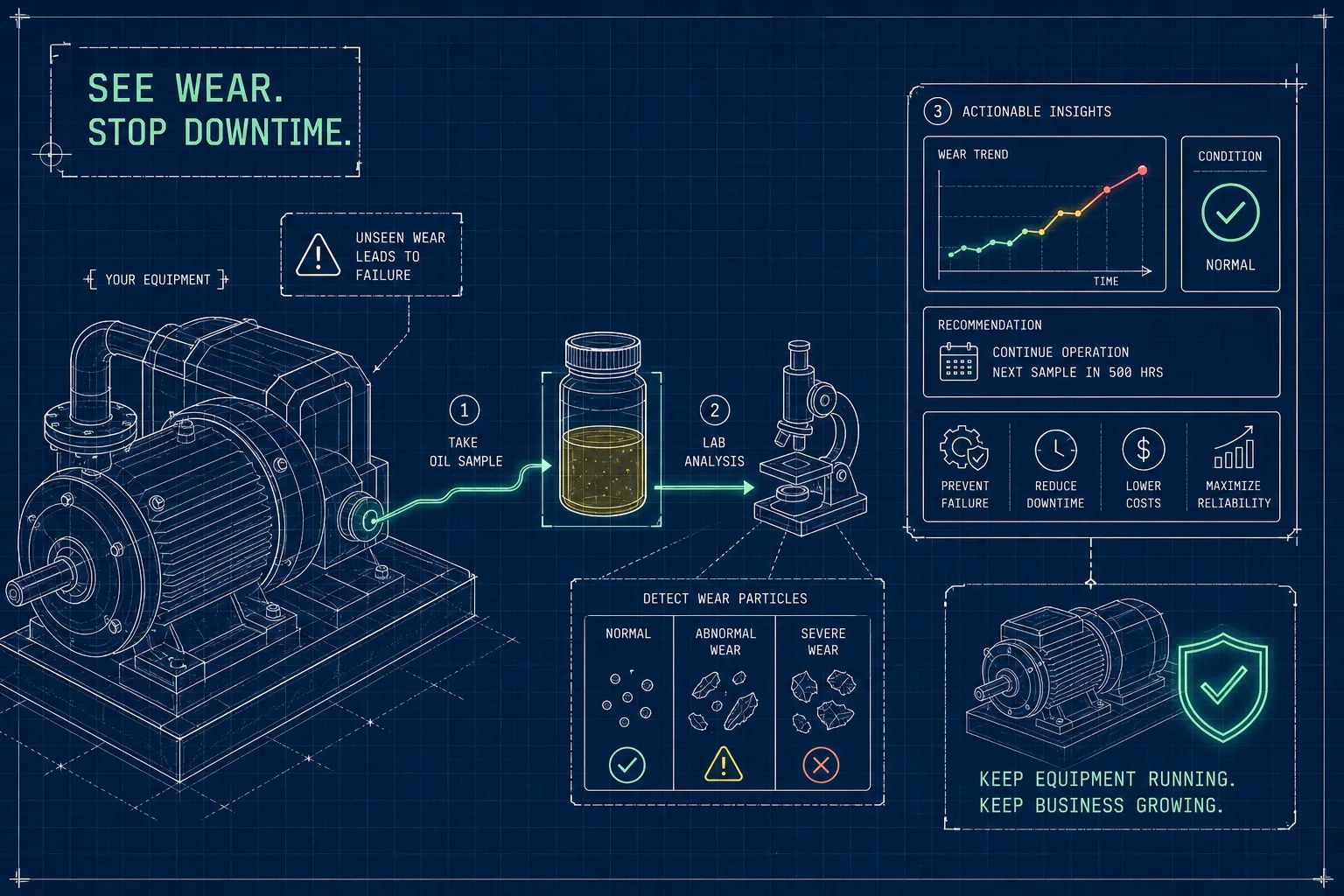

An unplanned equipment shutdown rarely announces itself. One shift, the engine is running normally; the next, you are staring at a seized bearing, a failed pump, or a gearbox that has ground itself to a halt. The parts cost is painful. The lost production time is worse. And the frustrating reality is that, in most cases, the failure had been developing over days, weeks, or even months, depending on the failure mode and equipment type.
Used oil monitoring, formerly known as used oil analysis (UOA), changes that equation. Instead of waiting for symptoms to appear on the outside, you read the oil. The lubricant inside your equipment is a continuous witness to everything happening at the component surfaces: wear, contamination, thermal stress, and additive depletion. A laboratory test panel decodes that evidence and tells you what is developing before it becomes a breakdown. Accredited laboratories running UOA programmes across Nigeria’s oil and gas, power, and manufacturing sectors report a consistent pattern: early detection through oil condition monitoring often delivers substantial savings compared to the reactive repair it prevents, with published maintenance benchmarking studies reporting 18- 25% lower costs versus purely preventive schedules and up to 40% lower costs versus reactive maintenance.
This article sets out the complete practical framework for used oil monitoring. You will learn which tests sit inside a standard UOA panel, how to collect samples correctly, how to read the results, how often to sample each equipment type, and what the return on investment actually looks like in real operational terms.
What a standard used oil monitoring panel actually tests
The core tests in a used oil monitoring panel
A used oil analysis panel is not a single test but a group of complementary measurements, each targeting a different failure mode. Understanding what sits inside the panel helps you use the results intelligently rather than waiting for a lab report to tell you what to think.
A standard lubricant analysis panel covers viscosity, wear metals (iron, copper, chromium, aluminium, and lead), water content, particle count, Total Acid Number (TAN), Total Base Number (TBN), and fuel dilution. Some laboratories also run FTIR spectroscopy, which detects oxidation, nitration, and additive depletion by comparing the used oil’s infrared absorbance pattern against a fresh oil baseline. The right panel for your operation depends on your equipment type, oil type, and the failure modes you are most concerned about.
What each test result is really telling you
Think of the oil as a report card from inside the machine. Viscosity change signals either thermal breakdown or contamination: oil that has thinned suggests fuel dilution or solvent contamination, while thickened oil points to oxidation or soot loading. Wear metals analysis identifies which component surfaces are eroding and at what rate. Iron typically traces to ferrous components such as gears, cylinders, and bearings; aluminium points to pistons, housings, or bearing alloys; copper implicates bushings, thrust washers, or oil coolers.
TAN and TBN tell you about the oil’s protective chemistry. TBN measures the remaining alkalinity reserve that neutralises combustion acids in engine oils; as it falls, the oil’s ability to protect surfaces declines. A rising TAN means acid is accumulating. These two numbers together tell you whether the oil is still fit for service or has been overtaxed.
Oil sampling best practice: how to collect samples correctly
Choosing the right sampling point and moment
A sample taken from the wrong location or at the wrong time will produce misleading results regardless of how capable the laboratory is. The sample must be representative of the oil actually circulating through your machine, carrying the wear debris and contaminants you need to detect.
Always sample while the equipment is running at its normal operating temperature and load. Draw from the active flow zone: upstream of filters and downstream of critical components such as bearings and gears. Filters strip out exactly the particles you need to measure, so sampling after the filter defeats the purpose. Flush the sampling valve and tubing thoroughly before filling the bottle, and never reuse disposable tubing between samples or between equipment.
Labelling, sealing, and shipping samples to the lab
A sample is only as useful as the information that accompanies it. At the moment of collection, record the equipment ID, sampling location, date and time, fluid type and grade, oil-in-service hours, and any recent maintenance events. Missing or inaccurate data makes trend analysis unreliable and can lead to the wrong maintenance decision.
Seal the bottle immediately after collection, store it in a cool and dark place, and ship it to the laboratory as promptly as possible. Consistent labelling and a consistent sampling location across every sample is what builds the trend data that makes oil contamination testing genuinely powerful over time. A single data point gives you a number; a trend gives you a story.
Used oil monitoring results: the warning signs that matter most
Wear metals and what rising values point to
The table below summarises common wear metal reference ranges used in diesel engine oil analysis, based on thresholds aligned with established guides such as the Joint Oil Analysis Program (JOAP). These are practical screening values; always interpret them in the context of your own equipment’s baseline trend and your OEM’s specific limits.
| Parameter | Normal | Caution | Action required |
| Iron (Fe) | <100 ppm | 101, 199 ppm | >200 ppm |
| Aluminium (Al) | <10 ppm | 10- 19 ppm | >20 ppm |
| Silicon (Si) | <60 ppm | 60, 100 ppm | >100 ppm |
| Copper (Cu) | <20 ppm | Rising trend | >20 ppm |
Iron above 200 ppm is a clear action threshold for most diesel engines. Aluminium rising above 20 ppm can indicate piston or bearing alloy wear. Silicon above 100 ppm usually signals dirt ingestion rather than internal wear, pointing you toward your filtration and sealing rather than component integrity. Chromium above 10 ppm and lead above 25 ppm are also established warning points for heavy-duty diesel applications.
A sharp upward trend from your own established baseline matters more than any single number in isolation. Equipment that normally runs at 60 ppm iron and suddenly reads 140 ppm deserves investigation well before it crosses the 200 ppm threshold.
Contamination markers: water, fuel dilution, and acid build-up
Water above 1,000 ppm (0.1%) is a hard limit in most programmes. Even a rising trend below this level is a red flag, because water promotes corrosion, strips additives, and creates conditions for microbiological growth in certain systems. Elevated sodium and potassium together often signal coolant contamination from a failing head gasket or cooler, and that diagnosis needs urgent attention.
Fuel dilution reduces viscosity and strips lubricity from the oil film. When you see a falling viscosity reading alongside rising wear metals, the combination tells you the oil has been compromised from two directions at once. A TAN climbing through successive reports while wear metals also rise is a reliable signal that the oil’s protective chemistry is exhausted and an oil change is overdue. These markers work as a checklist: each time a report arrives from the lab, check water, check fuel dilution, check TAN and TBN, then check the wear metal trend.
How often to sample diesel engines, hydraulics, and gearboxes
Standard starting-point intervals by equipment type
Sampling frequency should be shorter than the time it takes a defect to progress from detectable to failure. A practical rule is to set your interval at no more than half the expected P-F interval for the failure mode you are monitoring. The table below gives practical starting points.
| Equipment type | Standard interval | High-criticality interval |
| Diesel engines | Every 250 hours or each oil change | Two to three samples per maintenance cycle |
| Hydraulic systems | Every 500 hours | Per OEM guidance and contamination sensitivity |
| Industrial gearboxes | Quarterly | Monthly or every 250, 500 operating hours |
Adjusting frequency based on equipment criticality and history
New programmes should start with shorter intervals to establish a reliable baseline. Once the trend is stable and the equipment history is well understood, you can extend intervals for lower-risk assets without compromising the programme’s value. The goal is to invest monitoring effort where the consequence of failure is greatest.
Any abnormal result or recent maintenance event should trigger an immediate unscheduled sample before the next planned interval. Replacing a seal, changing a pump, or discovering a coolant top-up that was not recorded properly are all events that can alter the oil’s condition profile and warrant verification through oil condition monitoring.
The real cost of used oil monitoring versus the cost of not doing it
What used oil analysis costs in Nigeria
A comprehensive oil analysis panel in Nigeria typically runs in the region of ₦60,000 to ₦90,000 per sample for a full suite of tests, based on publicly available laboratory tariff schedules used as the closest available public reference for Nigerian industrial testing. Individual parameter tests can fall substantially lower, in the ₦5,000 to ₦15,000 range, making targeted oil contamination testing accessible for operations building a programme from a limited budget. Commercial lab pricing varies, so request a formal quote from your chosen accredited laboratory to confirm current pricing and scope for your specific panel.
Comparing that cost to an unplanned failure
A single unplanned shutdown on a production diesel engine or hydraulic press can consume multiples of your annual testing budget in lost production, emergency parts procurement, and contractor labour. Published maintenance benchmarking studies show that mature predictive maintenance programmes incorporating oil condition monitoring deliver 18, 25% lower maintenance expenditure compared to purely preventive schedules, and up to 40% lower costs compared to reactive maintenance. Some documented implementations have reported a return of between eight and ten times the amount spent on sampling and lab analysis in avoided costs, figures drawn from international ROI studies and cited here as an illustrative rule of thumb rather than a guaranteed outcome for every operation.
The value of used oil monitoring lies not in the cost of the test itself but in the failures those tests prevent, and in the oil changes they eliminate by confirming the oil is still serviceable. Both outcomes directly improve your operational uptime and reduce your maintenance spend.
Starting your used oil monitoring programme: a practical path forward
Building the programme from the ground up
The first step is identifying which assets are critical enough to monitor. Start with the equipment whose failure would cause the biggest operational or financial impact: typically production-critical engines, compressors, hydraulic presses, and high-load gearboxes. These are the assets where early detection pays for the entire programme.
Establish a baseline by running a full UOA panel on a fresh oil fill and again at a routine interval, so you have a solid reference point for all future trend analysis. From that point, standardise your sampling method across all assets: same location, same conditions, same technician protocol every time. Consistency is the foundation of meaningful trend data, and trend data is what transforms oil analysis from a snapshot into a genuine predictive tool.
Choosing an accredited laboratory that understands your industry
The quality of your results depends directly on the quality of the laboratory behind them. Nigerian operators in oil and gas, power, and manufacturing should look for a laboratory that holds demonstrable accreditation, uses internationally traceable analytical methods, covers the full used oil monitoring test panel, and provides clear result interpretation alongside timely turnaround.
Osten Laboratory Limited is one such option for operators in Nigeria. Working from hubs in Port Harcourt, Lagos, and Warri, Osten offers used oil monitoring and lubricant analysis services alongside LDAR and EHS consulting capabilities, giving maintenance teams a single point of contact for testing, interpretation, and regulatory support. Confirm the specific scope, accreditation status, and current turnaround times directly with any laboratory you engage before committing to a programme.
Reach out to Osten Laboratory to discuss a sampling plan tailored to your equipment and maintenance schedule. The conversation costs nothing; the first undetected bearing failure costs far more.
