

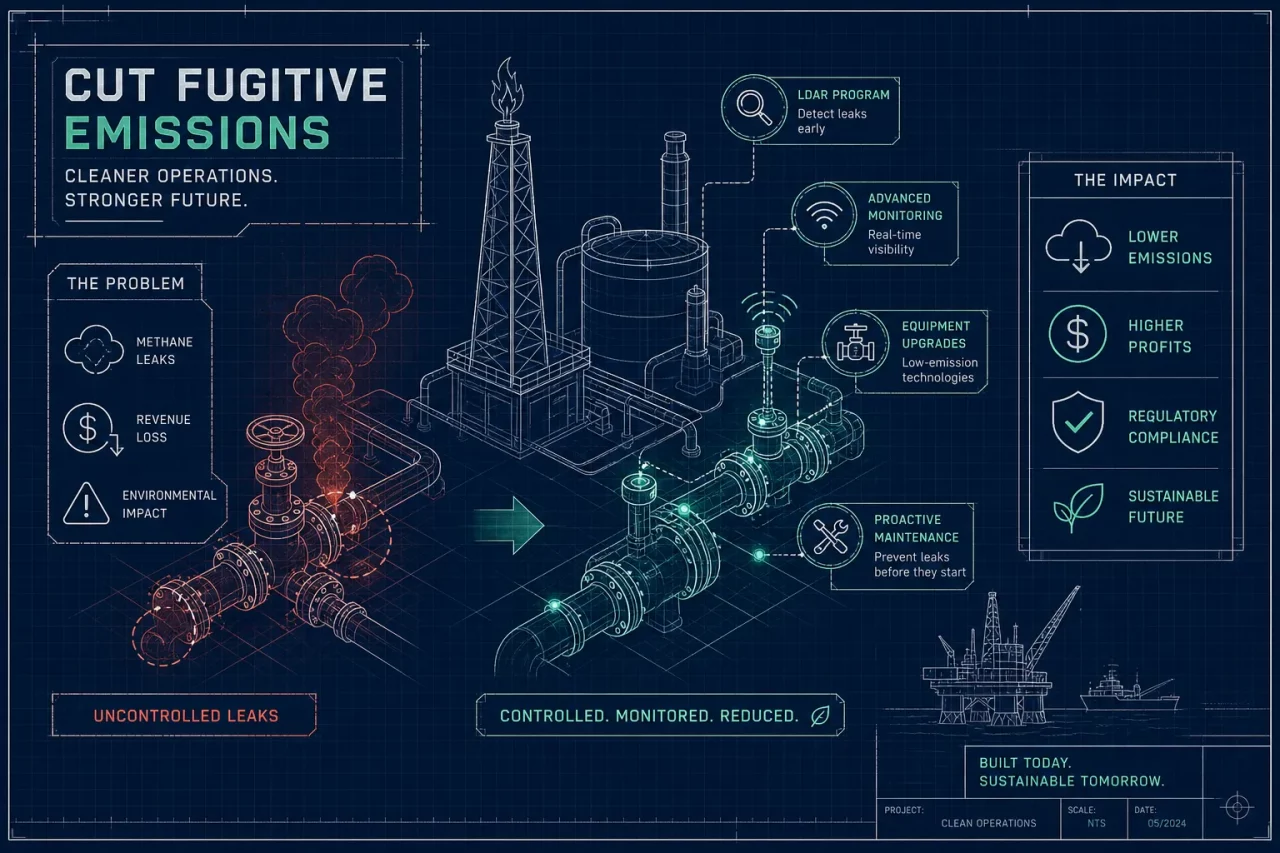

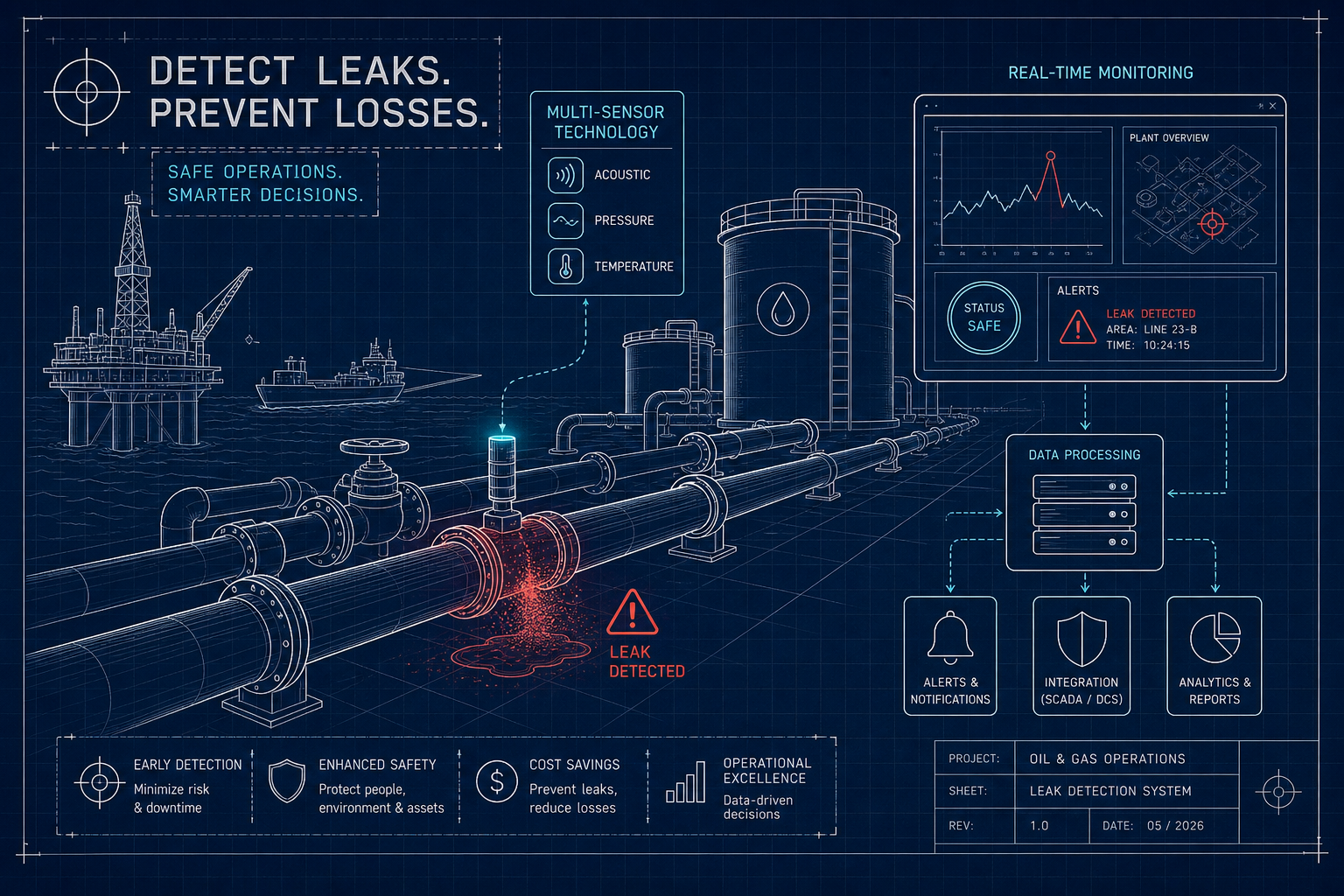
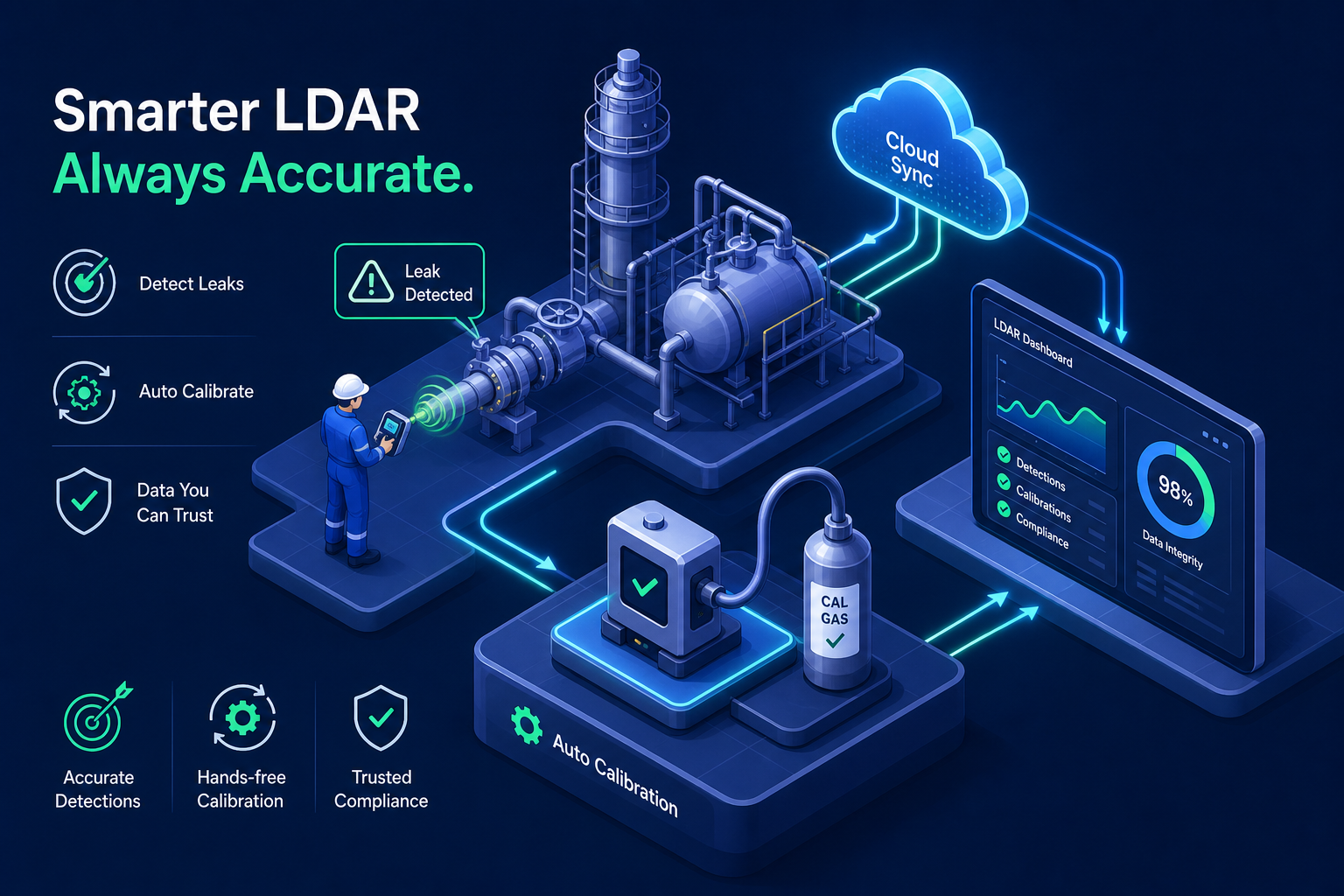
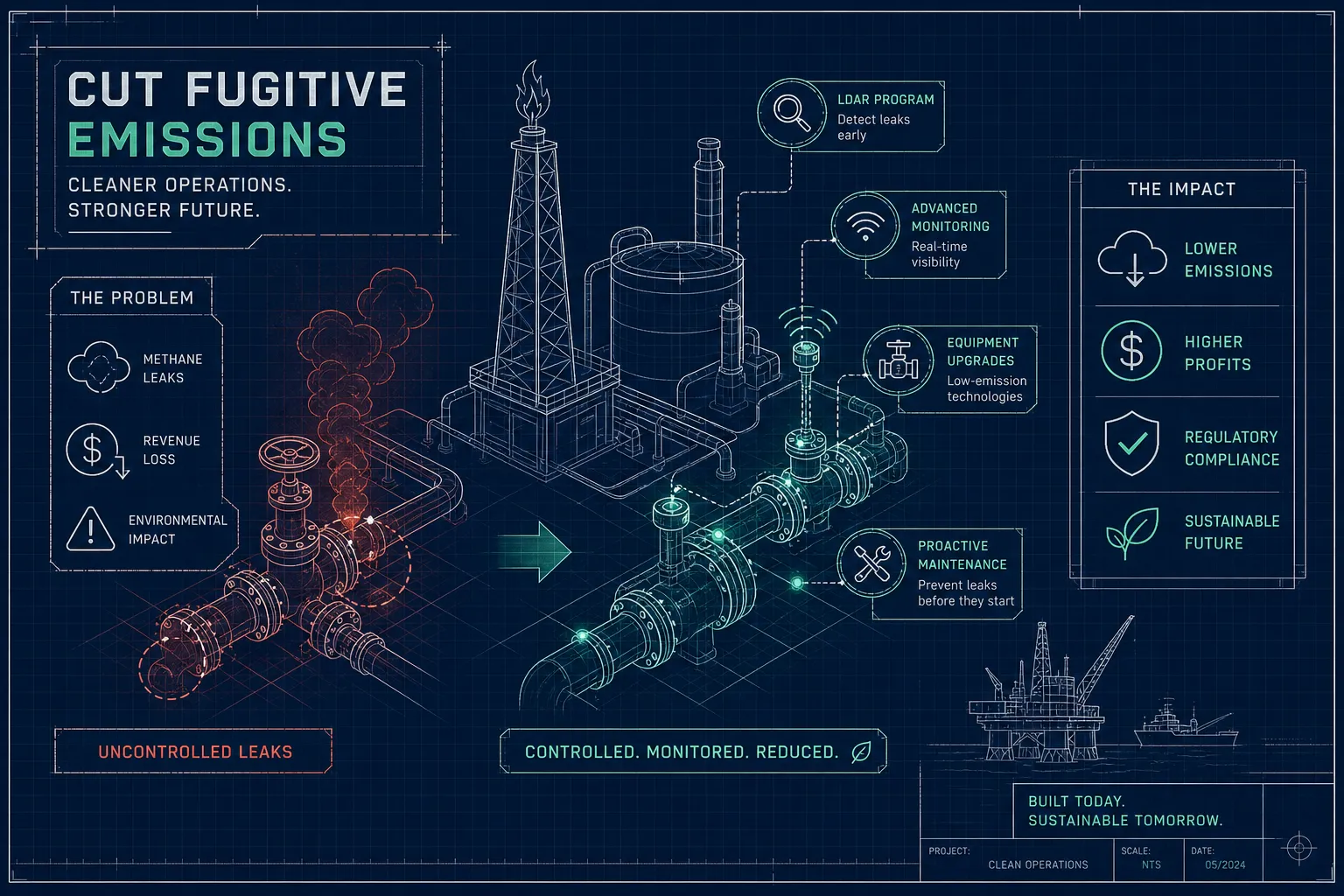
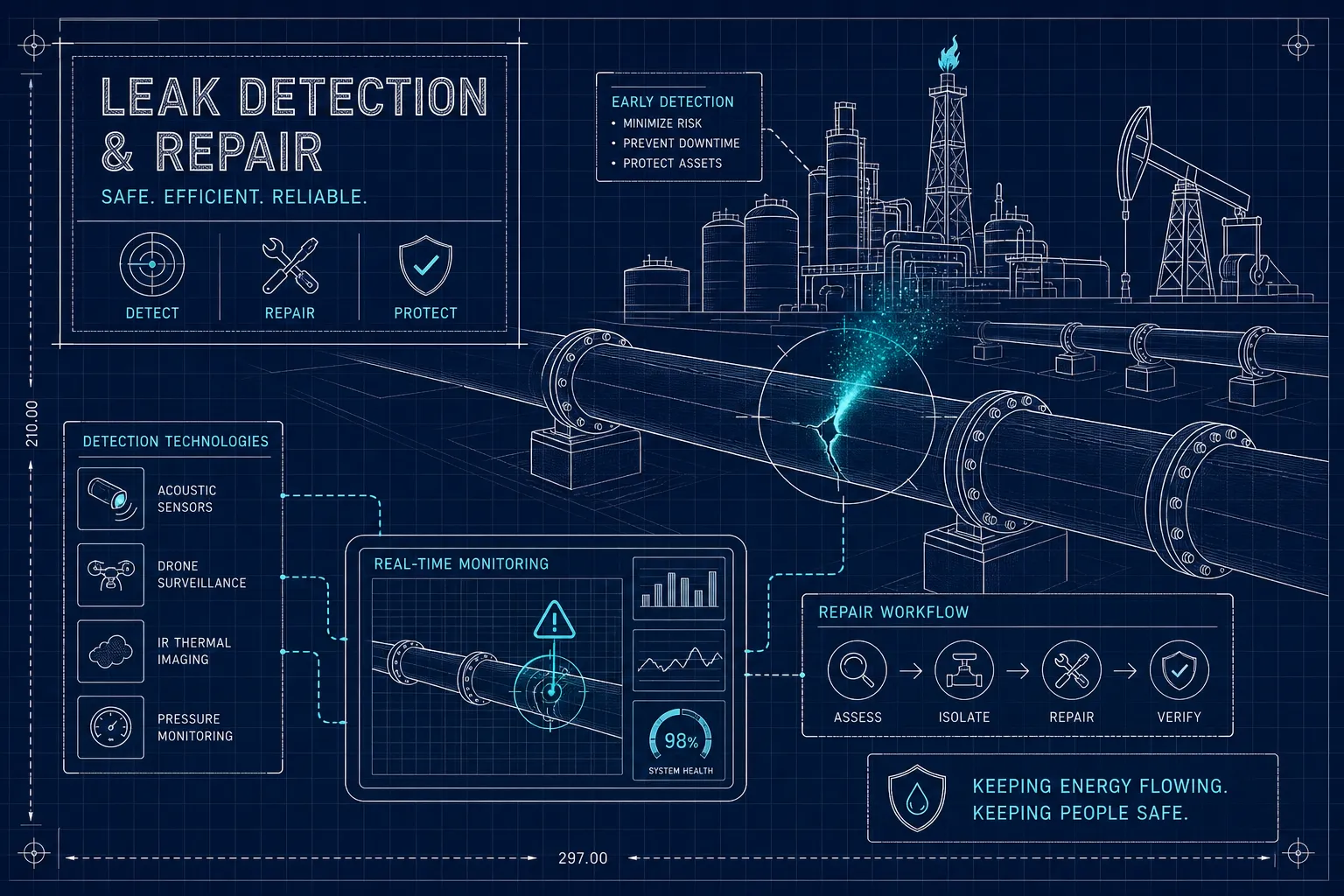
Nigeria’s oil sector accounts for roughly 60% of the country’s total methane output, and a significant share of that comes from fugitive emissions. These aren’t dramatic blowouts visible from the road. They’re invisible, continuous losses bleeding from corroded flanges, aging pneumatic controllers, and wellheads built before modern methane standards existed. Left unchecked, they drain revenue, accelerate regulatory exposure, and contribute disproportionately to climate impact.
So how can oil companies reduce fugitive emissions in Nigeria? The answer isn’t a single technology or a one-time audit. It requires a structured program built on regulatory compliance, systematic leak detection, targeted abatement investment, and credible measurement. The NUPRC has drawn a clear line: a 60% reduction in fugitive methane by 2031 and zero routine flaring by 2030. Many operators face a real compliance challenge if they delay, the time to start building is now. This guide walks through the full picture, from understanding regulatory obligations and mapping emission sources to selecting detection technology, setting up a credible MRV system, and financing the whole program.
What NUPRC Now Requires from Oil and Gas Operators
Nigeria’s fugitive methane framework sits on three legal pillars. The Petroleum Industry Act 2021 is the enabling statute that grounds all downstream regulation. NUPRC Guide 0024-2022 translates that into operational requirements for upstream operators. The Gas Flaring, Venting, and Methane Emissions Regulations of 2023 provide the enforcement backbone. Together, these instruments establish binding deadlines and enforcement mechanisms that operators cannot treat as advisory. For a practitioner-oriented review of what these monitoring obligations mean in practice, see Implications and Gains of the GHG Monitoring Guideline for Nigeria Oil and Gas Operators.
The Compliance Deadlines You Need to Know
Under Guide 0024-2022, operators were required to submit a GHG management plan and a company-wide fugitive emission inspection plan within six months of the guideline’s effective date. Flare tip replacement and related interventions carry an 18-month window. After the initial two-year compliance period, sputtering or smoking flares must be addressed within 60 days of detection. Quarterly LDAR-type inspections are mandatory for all onshore and manned offshore facilities, with in-house survey programs subject to six-monthly third-party verification. Annual test records and unlit flare records must reach NUPRC no later than Q1 of the following year.
What a GHG Management Plan Must Cover
A credible GHG management plan isn’t a one-page policy statement. It requires an emission inventory broken down by source category, defined inspection schedules with equipment-level coverage, documented repair protocols with tiered response timelines, flare management controls, and measurable performance targets tied to the national 60% reduction goal. Some operators have submitted skeleton documents that satisfy the paperwork requirement but would not survive a serious audit. The difference between a compliant plan and a genuinely auditable one is the depth of source-specific data and the integrity of the repair verification trail behind it.
Where Fugitive Emissions Come From in Nigerian Operations
Gas production alone contributes about 24% of Nigeria’s total national methane output, while oil production and gas flaring each add roughly 3%. The losses aren’t distributed evenly across a facility, which means operators can achieve outsized reductions by targeting a small number of high-emitting equipment categories first. Source mapping before spending on surveys is the most efficient starting point, and a practical answer to how oil companies can reduce fugitive emissions in Nigeria without deploying capital blindly. For a breakdown of the sources of CH4 (methane) emissions in Nigeria, consult independent national analyses that corroborate these sector shares.
The Equipment Types That Leak the Most
The six major source categories in Nigeria’s upstream operations are pneumatic controllers and pumps, valve packing and connector flanges, storage tank hatches and thief valves, wellheads and well production facilities, gathering pipelines, and flare stacks with incomplete combustion. Pneumatics are particularly problematic in the Niger Delta, where gas-driven devices remain common across facilities commissioned in the 1970s that have never been converted to air-driven or electric equivalents. According to widely cited LDAR industry studies, a single high-bleed pneumatic controller can vent substantially more methane annually than a large number of minor connector leaks combined, making pneumatic conversion one of the highest-impact interventions available.
Why Nigeria’s Infrastructure Age Makes the Problem Harder
By 2000, pipelines older than 20 years accounted for 73% of all Niger Delta pipelines. Most operators in the region are managing pipelines averaging over 30 years in service. High humidity, salinity, and microbial-induced corrosion accelerate failure rates, with rupture frequencies reaching 0.6 per 1,000 km-years in Rivers State alone. The practical consequence is that many leak points go undetected for months, not because they’re small, but because manual inspection intervals are too long and gas leak monitoring in Nigeria remains inconsistently deployed. Deferred maintenance doesn’t just raise repair costs; it compounds methane losses year on year.
How Can Oil Companies Reduce Fugitive Emissions in Nigeria, Building an LDAR Program That Works
An LDAR program is not a compliance checkbox. It’s a managed operational system with defined survey frequencies, component-level documentation, repair timelines, and verification records. NUPRC’s quarterly inspection requirement sets the minimum cadence, but facilities with high-emitting compressor stations or large pneumatic populations need more frequent surveys to stay ahead of leakage accumulation.
Running a credible program requires accredited expertise, especially for operators without in-house methane survey teams. Osten Laboratory Limited provides LDAR programs for upstream operators in the Niger Delta and beyond, covering component surveys, OGI-based screening, leak quantification, repair verification, and full compliance reporting aligned to NUPRC Guide 0024-2022. Operators who engage accredited third-party providers build a documented evidence trail capable of withstanding regulatory scrutiny, one that goes well beyond a standard survey summary. For practical detail on exact inspection and compliance obligations, see What are the exact LDAR compliance requirements for petroleum facilities?
What a Practical Inspection Routine Looks Like
Start with the highest-pressure, highest-volume equipment: compressors, separators, and gas processing skids. Work through pneumatic devices and connector flanges, then check storage vents and thief hatches. Every component surveyed gets documented with location, equipment ID, detection method, and emission rate estimate. As a best-practice framework used across the industry, repairs are typically assigned to priority tiers: immediate action for large leaks above a defined emission threshold, resolution within roughly five days for mid-range leaks, and scheduled repair within approximately 15 days for minor leaks. This approach concentrates repair resources where they deliver the most emission reduction per dollar spent.
How Optical Gas Imaging Fits the Nigerian Context
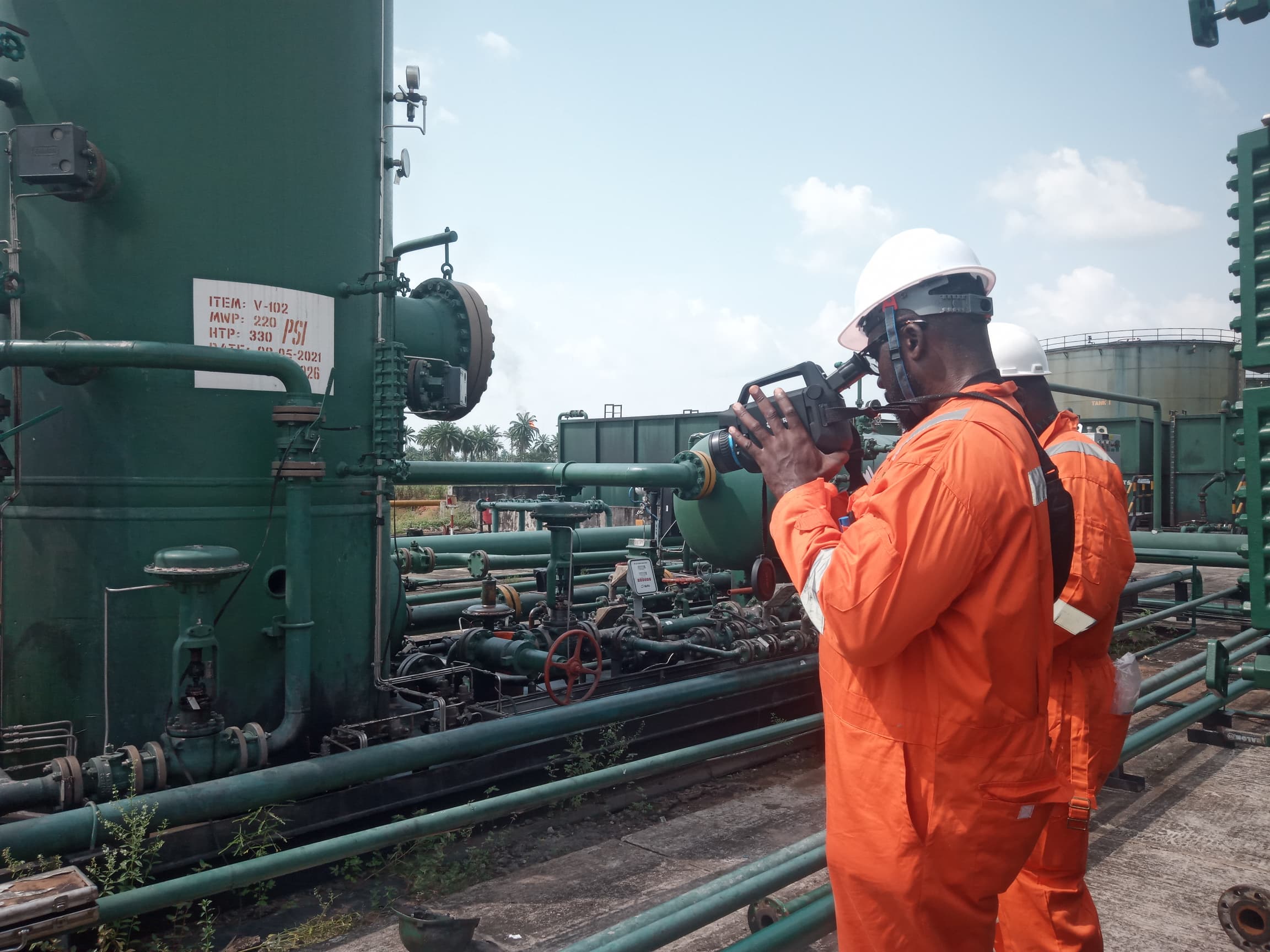
OGI infrared cameras are the primary detection tool for methane mitigation in Nigeria, and NUPRC Guide 0024-2022 explicitly references optical gas imaging as an approved detection method. These cameras visualize methane plumes that are completely invisible to the naked eye, allowing a trained operator to scan large numbers of components quickly. In field conditions, OGI performance is strongest on calm days with consistent thermal backgrounds, so surveys should be paired with handheld portable analyzers for concentration confirmation on flagged components. Camera purchase prices range from approximately $38,000 for entry-level units to over $118,000 for high-sensitivity G-Series instruments. For operators running quarterly programs, ownership is often more cost-effective than repeated rentals over a sustained period, depending on utilization and local logistics costs. For technical specifications and examples of optical gas imaging solutions, see manufacturer resources on optical gas imaging (OGI) cameras.
Technology Options for Detection, Monitoring, and Abatement
Beyond the core LDAR survey program, operators have a wider technology stack to draw on for both monitoring and active emission reduction. The right mix depends on facility type, emission profile, and capital budget, and understanding the cost tiers helps make the investment decision cleaner.
Detection and Monitoring Tools Compared
Organized from lowest to highest deployment cost, the available tools look like this:
- Handheld sniffers and portable analyzers: low CAPEX, high labor intensity, best used for leak confirmation after OGI screening.
- OGI infrared cameras: mid-range CAPEX, effective for component-level quarterly surveys, the standard tool for NUPRC-compliant LDAR.
- Continuous methane monitors: higher CAPEX per site, suited to compressor stations and tank farms with persistent or high-volume emissions, but still underdeployed in Nigeria due to infrastructure and power constraints.
- Satellite screening: near-zero local hardware cost, capable of detecting emissions above approximately 100 kg/hr in moderate wind conditions, useful for basin-wide prioritization and super-emitter identification. NOSDRA already uses the Nigerian Gas Flare Tracker for satellite-based monitoring, making integration with ground-truth LDAR programs a logical next step. Cloud cover in the Niger Delta limits reliability during certain seasons.
- Drones and UAVs: mid-range cost, valuable for pipeline right-of-way inspection and hard-to-access assets.
Abatement Technologies That Deliver Measurable Cuts
Vapor recovery units capture methane from tank vents and loading-rack emissions before they reach the atmosphere. At Nigerian domestic gas prices of approximately $2.18/MMBtu (effective April 2026), VRUs at high-throughput storage facilities can achieve favorable payback periods when recovered gas is sold or used on-site, though actual timelines depend on throughput levels and utilization assumptions. Flare gas recovery systems capture associated gas that would otherwise be flared. Converting pneumatic devices from gas-driven to air-driven or electric equivalents eliminates a persistent, continuous emission source. Taken together, these three abatement investments can cut facility-level fugitive methane substantially without requiring major process changes.
Measurement, Reporting, and Financing Your Program
Solid measurement data does two things at once: it satisfies NUPRC’s annual record submission requirement and unlocks access to carbon finance. Operators who treat MRV as a paperwork exercise forfeit access to carbon credit mechanisms that can offset a meaningful share of program costs.
Meeting NUPRC’s MRV and Reporting Requirements
The OGMP 2.0 framework is the internationally recognized methane MRV protocol that aligns directly with NUPRC’s reporting expectations. Level 4 reporting requires source-level methane quantification using direct measurements or asset-specific emission factors, moving beyond generic estimation tiers. Level 5 builds on that by adding independent site-level measurements and reconciliation of top-down and bottom-up inventories, the gold standard for methane reporting credibility. Operators who build their annual NUPRC submission around OGMP 2.0 data collection processes satisfy both frameworks without maintaining two separate emissions accounting systems. For a practical guide to OGMP 2.0 Level 4 and Level 5 reporting and measurement frameworks, consult industry reference materials on OGMP 2.0 reporting.
Financing Your Emissions Reduction with Grants and Carbon Credits
Nigeria has access to a practical financing mix for methane abatement. The CCAC provides technical assistance and LDAR capacity building for operators building out their first programs. The World Bank’s GGFR partnership supports flare reduction investments directly. The Development Bank of Nigeria, as Nigeria’s only direct-access entity to the Green Climate Fund, can provide on-lending and blended finance structures for emissions reduction projects. Carbon credits from verified emission reductions and green bonds are explicitly supported by Nigeria’s policy literature as supplementary financing channels. The Nigeria Gas Flare Commercialization Programme offers a compelling commercial route for operators with stranded associated gas, turning captured volumes into a revenue stream and improving project economics, though actual bankability outcomes depend on project-specific factors including gas volume, infrastructure readiness, and offtake arrangements.
A Phased Implementation Checklist for Operators
The compliance calendar is clearly defined. Operators who structure their programs in two phases, foundations first, then scale-up, can meet the 2031 methane reduction target without compressing everything into a single costly sprint.
Year 1: Foundations and Quick Wins
- Submit your GHG management plan and company-wide fugitive emission inspection plan to NUPRC if not already done.
- Conduct a baseline OGI survey across all high-priority facilities to identify super-emitters and build your initial emission inventory.
- Repair all large leaks promptly upon detection and document every repair with pre- and post-repair verification data, industry best practice targets resolution within 30 days, though your specific regulatory obligations under NUPRC should govern the timeline.
- Replace or repair sputtering, smoking, or pilot-deficient flares to bring flare performance into compliance.
- Engage an accredited LDAR service provider, such as Osten Laboratory Limited, to run quarterly inspections, produce component-level documentation, and manage the NUPRC reporting cycle on your behalf.
Year 2 and 3: Scale-Up and Continuous Improvement
Expand OGI survey coverage to lower-priority assets identified in the baseline. Deploy continuous methane monitors at compressor stations and tank farms where persistent emissions justify real-time surveillance. Install VRUs at high-throughput storage and loading facilities to convert emission losses into recoverable revenue. Integrate OGMP 2.0 reporting protocols across your asset base to qualify for carbon finance mechanisms. Convert remaining gas-driven pneumatic devices to air-driven or electric equivalents to eliminate a chronic, year-round methane source.
Operators who build this systematically, starting with the regulatory foundations and working through detection, repair, abatement, and MRV, will be ahead of the 2031 deadline. Those who don’t will be managing a compliance gap they could have avoided. The infrastructure for compliance already exists. What separates operators who are ready from those who aren’t is execution.
If you’re reviewing your compliance position or building your program from the ground up, Osten Laboratory Limited can walk through where your operations stand and what a credible reduction plan looks like for your asset base. Our team works with oil and gas operators across Nigeria on the full program cycle, from initial OGI baseline surveys through quarterly LDAR inspections, repair verification, and NUPRC-aligned annual reporting. Contact us to discuss how oil companies can reduce fugitive emissions in Nigeria at your specific sites.
